How AI Automation is Transforming Business Operations in 2025
Introduction
In the current digital era of accelerated pace, AI automation has transitioned from being a futuristic idea to an essential business requirement. Businesses in all sectors are leveraging artificial intelligence to automate processes, reduce expenses, and drive greater productivity.
From predictive analytics to autonomous decision-making, AI is revolutionizing the manner in which organizations function, grow, and innovate.
Here in this blog, let's see how AI automation is transforming business operations in 2025 and how your business can harness it for exponential growth.
1. Workflow Automation: From Manual Tasks to Intelligent Operations
Manual workflows are prone to errors and time-consuming. However, with AI automation software, companies can now eliminate tasks like data entry, document processing, and scheduling.
Examples of AI-based workflow automation:
Email sorting and response generation automation
Smart data extraction from PDFs and spreadsheets
AI-driven report writing and summarization
Predictive task allocation in project management
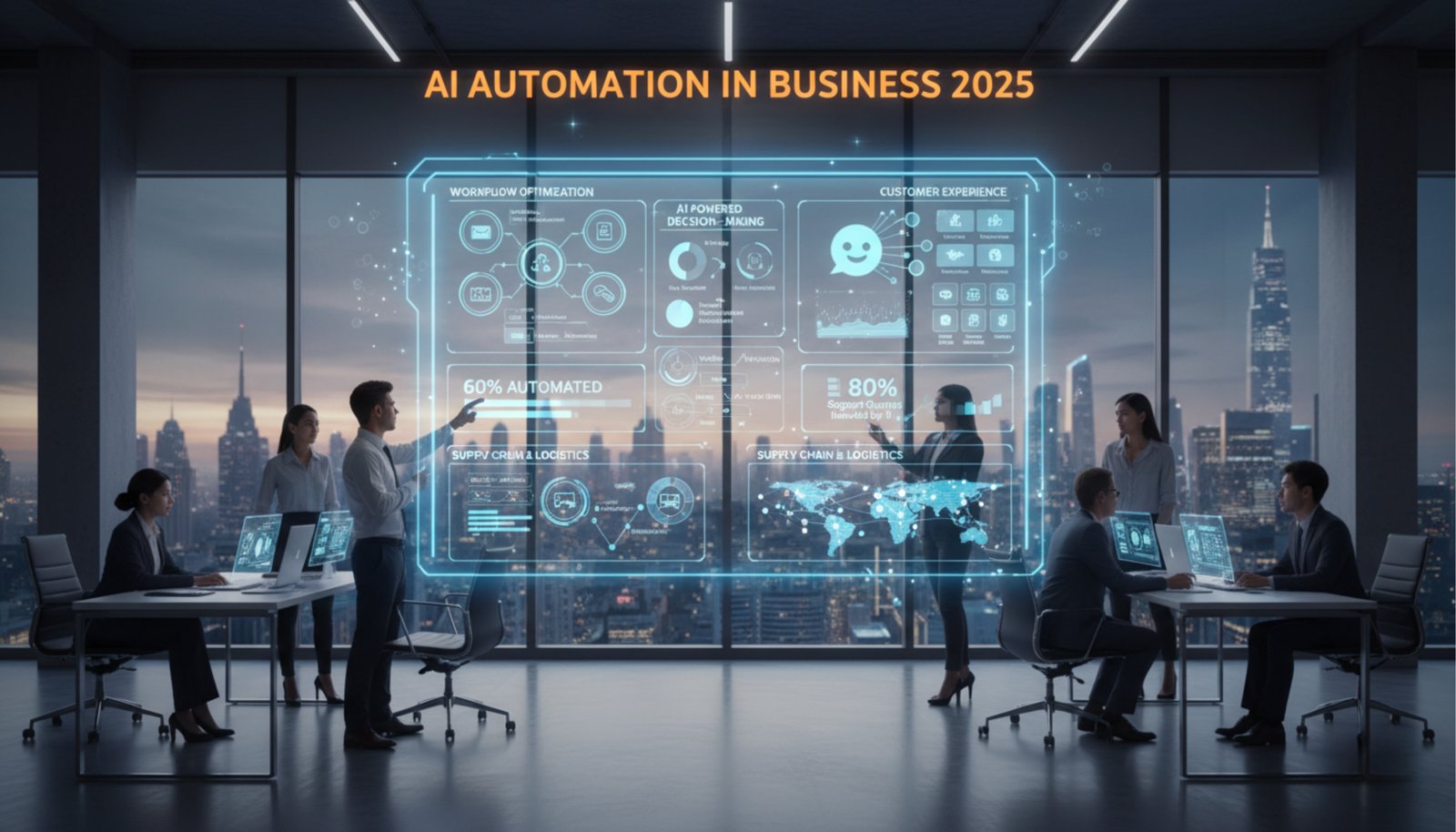
With the incorporation of tools such as Google Cloud AI or OpenAI APIs, businesses can automate as much as 60% of operational processes.
2. AI-Powered Decision-Making
AI doesn't merely automate tasks - it makes them more intelligent.
By using sophisticated data analysis and predictive modeling, AI enables organizations to make quicker, data-based decisions.
Use cases:
Machine learning-based sales forecasting
Predictive maintenance in manufacturing
Risk assessment in finance and insurance
Demand forecasting in retail
AI automation tools don't substitute human beings; they enhance human thinking - allowing leaders to make faster, smarter decisions.
3. Enhancing Customer Experience through AI
Customer experience (CX) is a major differentiator today. AI-powered automation enables brands to offer customized, real-time, and proactive service.
AI in customer operations:
24/7 smart support through chatbots
Customer emotion detection using sentiment analysis
Recommendation engines for targeted product recommendations
For example, virtual assistants powered by AI can now resolve up to 80% of support requests, allowing human agents to concentrate on complicated issues.
4. AI in Supply Chain and Logistics
AI automation is transforming supply chain management - providing real-time visibility, predictive demand planning, and optimized inventory.
Key benefits:
Foresee stock shortages ahead of time
Route deliveries optimally with AI
Use data insights to analyze supplier performance
Logistics operators with AI automation have achieved cost savings of 20–30% and improved delivery efficiency in 2025.
5. The Future: Cognitive Automation and Beyond
We are entering the age of cognitive automation - where not only do AI execute the tasks, but also learn and evolve every moment.
With technologies such as Generative AI, Natural Language Processing (NLP), and Computer Vision, enterprises can automate creative, analytical, and operational tasks seamlessly.
“The companies that embrace AI automation today will define the future of business tomorrow.”
Conclusion
AI automation is not merely about time-saving - it's about unleashing intelligence and innovation in every business function.
As we move further into 2025, businesses embracing automation solutions from pioneers like VedaSynth AI Solutions will reap a meaningful competitive edge - intelligent operations, satisfied customers, and increased ROI.
Recent Post